
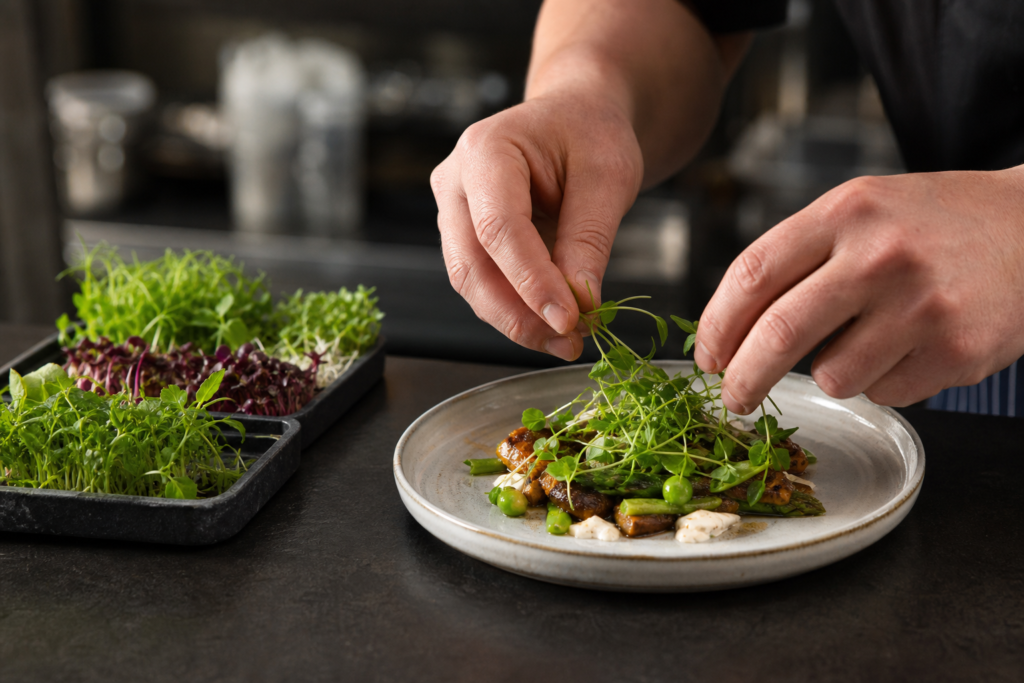
Restaurants want new ideas. They also need those ideas to survive a busy service, a tight margin and a kitchen that has no time for unnecessary complexity.
That tension appears in a recent foodservice report highlighted by Frozen Food Europe. Bidfood says operators are using innovation to respond to changing customer expectations while managing pressure on cost, labour and efficiency. The article cites separate research suggesting that half of foodservice operators surveyed are prioritising new products.
That is an interesting signal—but it is not proof that every restaurant wants microgreens, or that a new supplier will automatically find demand.
The more useful lesson is narrower: a chef may be open to something new when it is also easy to understand, relevant to the menu and practical to use.
For a local microgreens supplier, that changes the first question. Instead of asking, “How do I convince restaurants to buy microgreens?”, ask: “How could this product make sense in the reality of this kitchen?”
Innovation has to work on an ordinary Tuesday
The word “innovation” can sound grand. In a restaurant, it may be something much smaller: a fresh flavor that completes a dish, a texture that creates contrast or a visual detail that helps a seasonal plate feel distinctive.
But the product still has to arrive in the right format, at the expected time and in a condition the kitchen can use.
The foodservice report makes this practical tension clear. It says interest in new flavors and ingredients can sit alongside concerns about taste and price. It also describes successful innovation as something that must be understandable, appealing and workable for operators.
That gives a local supplier a useful filter:
- Is the product relevant to something already happening on the menu?
- Can the chef understand its flavor and possible use quickly?
- Can you supply it consistently in a suitable format?
- Does the price make sense for the value it adds?
- Will ordering, receiving and using it be straightforward?
A beautiful sample may attract attention. A product that fits the kitchen has a better chance of earning a second conversation.
The wider market is adding pressure, not certainty
Other recent European updates show why practicality matters.
On 27 July, the European Commission’s Joint Research Centre reported that repeated heatwaves and limited rainfall had depleted soil moisture across parts of western and central Europe. Its latest crop-monitoring update described effects on summer crops and downward revisions to several yield forecasts.
A separate European Commission agricultural outlook, published on 22 July, points to uncertainty around energy markets, weather and trade. It says rising input costs are putting pressure on producer margins.
These reports concern broad agricultural markets and field crops. They do not predict the results of a microgreens business, prove that indoor production is immune to weather or establish an environmental advantage for Hy-Farm.
What they do show is that food businesses are making decisions in an environment where cost, supply and operating conditions deserve careful attention. A restaurant considering a new ingredient may therefore ask practical questions before it asks for a brand story:
- Can you supply the product when promised?
- How stable is the price?
- What happens if a crop is not ready?
- How quickly can the kitchen adjust an order?
- Can you provide a format that reduces unnecessary handling?
The supplier who can discuss those questions honestly is more useful than one who simply repeats that local food is better.
“Local” becomes meaningful through service
Proximity can create possibilities. It does not create value on its own.
A local supplier may be able to learn directly from a chef, adapt the product mix over time and build a compact delivery route. But those possibilities matter only when the routine behind them works.
Being nearby does not excuse a late delivery. A short route does not guarantee consistency. Indoor production does not remove the need to manage energy, water, hygiene, crop timing and operating costs.
The strongest local story is therefore observable:
- The supplier listens to the kitchen.
- The sample is selected for a real use.
- Feedback shapes the next trial.
- The order is confirmed clearly.
- Production is planned against demand.
- Delivery happens as agreed.
That is less dramatic than claiming to transform food supply. It is also more credible—and more relevant to a chef.
A sample should answer a menu question
When operators hear that restaurants are interested in new products, the temptation is to prepare a large selection and visit as many kitchens as possible.
A focused sample is usually more informative.
Start with the restaurant’s current menu. Look for a dish, service format or seasonal direction where flavor, texture, color or presentation visibly matters. Then choose only products you can reproduce consistently and that could plausibly suit that context.
Ask the chef to evaluate something specific:
- Does the flavor work with the intended dish?
- Is the texture useful at the point of service?
- Does the format suit the kitchen’s workflow?
- What quantity would allow a meaningful trial?
- What would stop the team from ordering it again?
The last question may teach you more than a compliment.
Do not treat “interesting” as an order. Agree on a clear next step: a defined trial, a different variety, a price discussion or a decision that the product is not relevant now.
Reliability is part of the product
Foodservice innovation is often discussed in terms of ingredients, formats and trends. For a small supplier, reliability is part of the innovation too.
A chef may enjoy discovering a new flavor. The purchasing relationship depends on quieter details:
- accurate product and quantity confirmation;
- clear price, taxes and payment terms;
- agreed delivery windows;
- appropriate labeling and handling;
- prompt communication when something changes;
- a planned moment to review the trial.
These details help a kitchen decide whether a product is merely interesting or genuinely usable.
They also protect the supplier. Clear orders can be connected to crop planning. A focused delivery area can reduce route complexity. Honest feedback can prevent repeated production of a variety that attracts curiosity but not demand.
The news is a prompt to ask better questions
Recent reporting does not justify a headline that “restaurants are demanding microgreens.” The evidence does not say that.
It points instead to a more useful opportunity: foodservice operators are looking at new products while remaining highly aware of cost and operational pressure. A local microgreens supplier can respond by making the first conversation more relevant, not more promotional.
Before approaching a restaurant, ask:
- What on this menu suggests that the product may belong here?
- What practical problem or creative possibility could the sample explore?
- Can I supply this variety and format consistently?
- What would the chef need to know before agreeing to a trial?
- If the answer is no, what can I learn without applying pressure?
That is how industry news becomes useful at street level: not as a promise of demand, but as a reason to listen more carefully.
Where Hy-Farm fits
Building restaurant relationships is local work. Hy-Farm does not provide a guaranteed client list, and no industry trend removes the need to validate demand.
Hy-Farm’s current system combines production, marketing and sales training with an online learning platform and 12 weekly one-to-one sessions during the first three months. The purpose is to give new operators a structure for working through real questions as they appear—from choosing relevant prospects to interpreting the feedback after a sample.
The operator remains responsible for production, outreach, delivery, follow-up and the quality of each customer relationship.
For anyone testing a local market this week, the next step can be very small: choose one restaurant you can realistically serve and ask what would make a new ingredient genuinely useful in its kitchen.
The answer may be less exciting than a trend headline. It will be far more valuable.
Sources
- European Commission Joint Research Centre: Heatwaves impact summer and winter crops, 27 July 2026
- European Commission: Summer 2026 short-term outlook for EU agricultural markets
- Frozen Food Europe: Bidfood highlights innovation as foodservice operators adapt to shifting consumer demand, 15 July 2026